The 1970s late 1970s
The Bias Cut Revival
A 1930s draping technique comes back for disco - cutting fabric on the diagonal grain so jersey clings and pours over the body without a single dart.
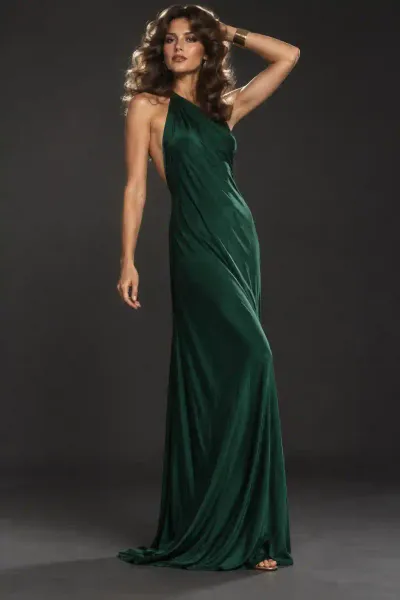
Bias cutting isn't a 1970s invention - Madeleine Vionnet was doing this in Paris in the 1920s and '30s, and if you want the real origin story you have to start with her. But the technique goes quiet for decades once fitted, structured tailoring takes over mid-century, and its return late in this decade, mostly through Halston's work, is genuinely a revival in the specific, meaningful sense - a deliberately resurrected historical method, not a fresh invention getting credited to the wrong era.
The actual technique is worth being precise about, because it's easy to describe vaguely and miss why it works. Woven fabric has a grain - the lengthwise and crosswise threads running at a right angle to each other - and cutting a pattern piece so its edges run at roughly 45 degrees to that grain, rather than parallel to it as conventional cutting does, exploits the diagonal's natural give. Fabric cut on the straight grain is dimensionally stable and holds a shape; fabric cut on the bias stretches and drapes because the diagonal weave has nowhere near the same resistance, which is exactly why a bias-cut garment can skim close over the hip and bust with essentially no darts or fitted seams doing that work instead. It's a genuinely different way of getting a fitted silhouette - not fabric held in place by construction, but fabric relying on the grain itself to fall and cling correctly, which also makes it notoriously difficult to sew: bias-cut pieces stretch unevenly on the cutting table and under the machine foot, and a skirt hung on the bias needs to rest for a day or more before the hem is leveled, because gravity keeps pulling it slightly out of true even after it's sewn.
Halston is the person who actually brings this back into mainstream fashion consciousness for the decade, applying bias cutting to jersey rather than the silk crepe Vionnet favored, which suits both the technique and the moment doubly well - jersey already drapes, and cutting it on the bias on top of that produces exactly the body-skimming, no-underpinning-needed cling that the disco silhouette wanted for a body moving under club lighting rather than standing still under gallery lighting. I think that pairing - a 1930s couture technique meeting 1970s stretch jersey and dance-floor practicality - is what makes this a genuine revival rather than a costume reference, and it's a good example of how a construction method can outlive the specific era it was invented in and still turn out to be exactly the right tool for a completely different decade's problem.