The 1990s early-to-mid 1990s
Riot Grrrl
The feminist punk movement that came out of Olympia, Washington, and Washington, D.C., in 1991 - photocopied zines, girl bands, words written on skin in lipstick and marker, and thrift-store girlishness worn with heavy boots.
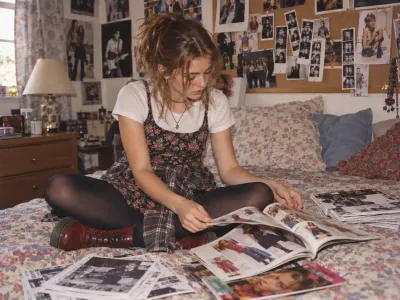
Most of the movements on this site left clothes behind. Riot grrrl mostly left paper. When the Fales Library at New York University opened its Riot Grrrl Collection in 2011, what came in were zines, flyers, letters and diaries; Kathleen Hanna's papers there run to posters, notebooks, photographs and tapes. That suits a movement whose best-known singer told girls to "stop always worrying about what you look like and what clothes you wear." And yet what riot grrrls wore, and above all what they wrote on themselves, is the picture everyone kept.
It started in Olympia, Washington, a town of about 34,000 people and home to The Evergreen State College. Hanna, an Evergreen student born in 1968, formed Bikini Kill with Tobi Vail, Kathi Wilcox and Billy Karren. Allison Wolfe and Molly Neuman, who had met at the University of Oregon, led Bratmobile. In the summer of 1991 both bands were living in Washington, D.C., and in July Hanna, Neuman, Wolfe and their friend Jen Smith put together a handmade mini-zine titled Riot Grrrl. Its first issue complained about "the general lack of girl power in society as a whole, and in the punk underground specifically." On 20 August, back in Olympia, Girl Night opened K Records' International Pop Underground Convention at the Capitol Theater with a bill of all-girl and girl-fronted bands.
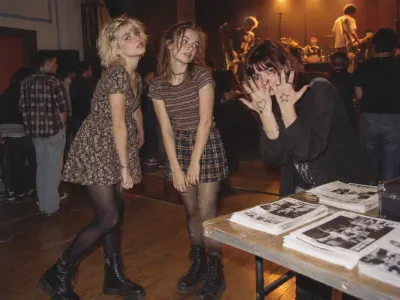
The writing on the body is what people remember. On stage Hanna often wore little more than a bra top, with SLUT written across her midriff, in lipstick by HistoryLink's account - the insult worn before anyone could throw it. As an Evergreen student in 1989 she made a dress lettered "As he drug her upstairs by her neck" as the centrepiece of a fashion show she organised in the college library. Writing on skin is a different act from printing a T-shirt: it can't be bought, it smudges by the end of the night, and it says the body underneath is the subject. Girls in the audience picked it up. Sara Marcus recounts a photocopied flyer suggesting that "pro-revolution girls" find each other by writing on their hands with Magic Marker: "You can draw hearts or stars or write words on yr fingers, whatever."
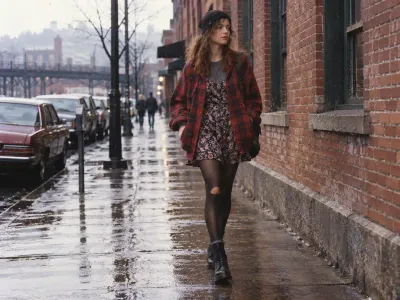
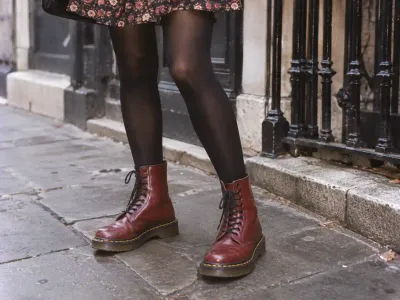
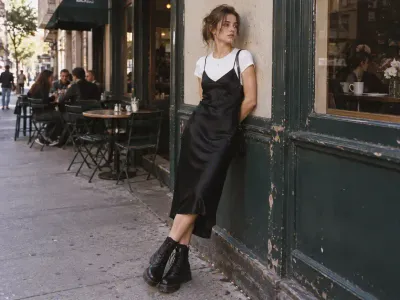
The clothes themselves were thrifted and cheap. George Mason University's special collections sums them up as short skirts and "girlish barrettes" mixed with combat boots and choppy dyed hair, with a strong streak of gender-bending; pink, sequins and hearts dotting the i's turned up on handmade zines and T-shirts. The proportions owe something to the 1960s babydoll, but this was childishness worn as an argument, usually over Dr. Martens, and closer in spirit to the jumble-sale punk girls of 1970s London than to the grunge look it was often filed under. "You might easily think of it as a cutesy, girly, Hello Kitty kind of movement," the Fales archivist Lisa Darms told NPR. "But there was anger and there was danger and there was truly radical intent."
That intent was hard to photograph, and the press photographed the rest. Sassy championed the bands early through its "Zine of the Month" and "Cute Band Alert" columns, as the Sassy entry follows; then came Spin, The New York Times and a 1992 Newsweek story that called riot grrrls "sexy, assertive and loud." By late 1992 there were calls for a total media blackout. The zine Cupsize attacked a Village Voice fashion feature, writing that "the politics get watered down somewhere between the Riot Grrrl signifying aesthetic and the SKU coding of the price tag." Vail put it more bluntly in her zine Jigsaw: "everybody's talking about what kind of girl, nobody's starting a riot." The original movement had largely broken up by 1996, and Bikini Kill split in 1997. The phrase in that first zine went on without them, cleaned up for pop as the Spice Girls' "girl power."
Sources
- Rita Cipalla, "Riot Grrrl" - HistoryLink.org Essay 22505, 2022
- Rachel Smith, "Revolution Girl Style, 20 Years Later" - NPR, 22 September 2011
- Laura Havlin, "The Riot Grrrl Style Revolution" - AnOther, 4 February 2016
- Johanna Fateman, "Her Jazz" (review of Sara Marcus, Girls to the Front) - Bookforum, Fall 2010
- Kathleen Hanna Papers, 1988-2015 (MSS 271), finding aid - Fales Library and Special Collections, New York University
- Maris Tiller, "From the Archives: The Riot Grrrl Collection" - Vault217, George Mason University Libraries Special Collections Research Center, 27 April 2026
- Hilary Malatino, "The Becoming-Woman of the Young-Girls: Revisiting Riot Grrrl, Rethinking Girlhood" - Rhizomes 22, 2011