The 1990s throughout the 1990s
Dr. Martens Boots
The air-cushioned, yellow-stitched work boot designed by a German doctor and made in Northamptonshire from 1960 - adopted by skinheads, punks and goths before becoming the 1990s' favourite boot to wear with a dress.
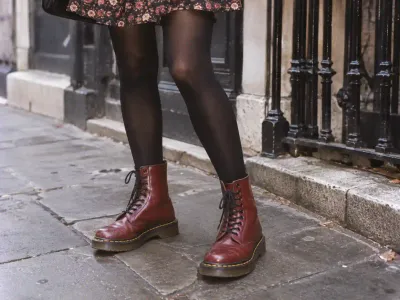
Dr. Martens boots are one of those rare pieces of clothing that have belonged to almost every youth movement in Britain since the 1960s. But the 1990s were probably their peak, when they became the everyday boot of a whole generation - and when young women made them part of a completely new look.
Their story starts with an injury. Klaus Märtens, a German army doctor, hurt his ankle skiing in 1945 and found his boots uncomfortable, so he designed a boot with a sole containing pockets of air to cushion each step. With a friend, Herbert Funck, he began producing boots with these air-cushioned soles in Germany. In 1959, the British shoemaking company R. Griggs, in Northamptonshire, bought the licence, reshaped the boot, and added the now-famous yellow welt stitching and heel loop. The classic eight-hole boot went on sale on 1 April 1960, which is why it's called the 1460.
At first it was a cheap, tough work boot for postmen, factory workers, and police officers. Then young people adopted it. Skinheads wore Dr. Martens in the late 1960s, punks in the 1970s, and goths and indie fans in the 1980s. Each group gave the boots a different meaning, but they always suggested toughness and rebellion.
In the 1990s, they were everywhere. Grunge fans wore them with jeans and flannel shirts, Britpop fans with drainpipe jeans and parkas, and students and teenagers simply wore them every day. For women, the most distinctive 1990s look was the combination of Dr. Martens with something feminine: a floral dress, a slip dress, a short skirt, and tights. The heavy, practical boot made the delicate dress look tougher and more modern, and it was a way of being girly without being fragile.
I find Dr. Martens fascinating as a shoe that absorbs meaning from whoever wears it. They were designed as orthopaedic footwear, sold as workwear, and adopted by rebels, and by the 1990s they had become almost a neutral basic. The company's sales peaked in the late 1990s, and although they struggled afterwards, the boots have come back again and again - still with the yellow stitching and air-cushioned sole.