The 1950s 1950s
Swing Coat
A loose, flared coat cut wide through the back to swing away from the body - practical outerwear built to accommodate the era's full underlying skirts.
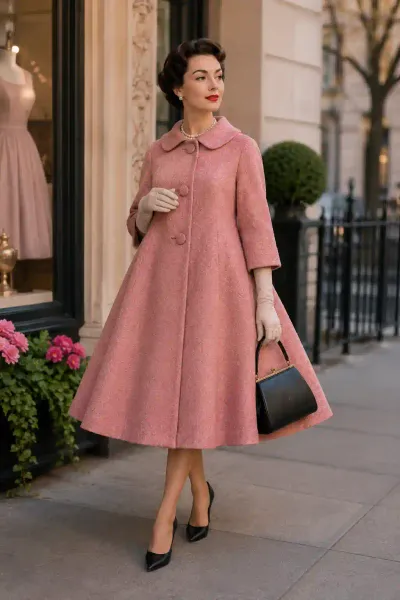
Outerwear has a real design problem in this decade that's easy to overlook - how do you cover a full circle skirt and its petticoats without either swallowing the whole silhouette or getting hopelessly bulky? The swing coat's answer is to lean into the fullness rather than fight it.
The cut that makes it work is really about where the fullness gets added and how it's allowed to move. Rather than a fitted coat body with a separate flared skirt panel stitched on at the waist, a proper swing coat is typically cut with the flare built into the same pattern pieces running the coat's full length - often through extra-wide back panels, sometimes with a box pleat or inverted pleat set into the center back specifically to release additional fullness right where a full underlying skirt needs the most clearance. The shoulder tends to stay relatively fitted and structured, so the coat doesn't look shapeless from the front or in a fitted photograph, while all that generous swing is doing its real work lower down and toward the back, exactly where a circle skirt and its petticoats actually need the room.
That combination - structured shoulder, flared body - is what lets the coat read as a genuinely tailored, fashionable piece rather than just a big loose sack thrown over everything underneath, which was a real risk given how much volume it needed to accommodate. I think the swing coat is a good small case study in a design principle that runs through a lot of this decade's better outerwear: solving a practical problem (fitting over a huge skirt) doesn't have to mean abandoning shape entirely, it just means moving the fitted parts to where they'll actually show and letting the rest of the garment do its practical job unfitted. It's the same logic, really, as pairing a boned, structured cocktail-dress bodice with a much simpler skirt below - put the tailoring where it earns its keep, and let the rest of the garment breathe.