The 1950s late 1940s into the 1950s
Poodle Skirt
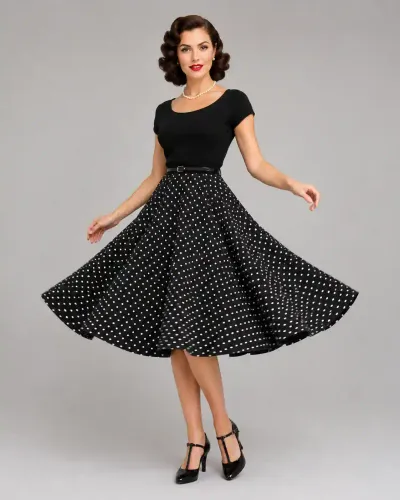
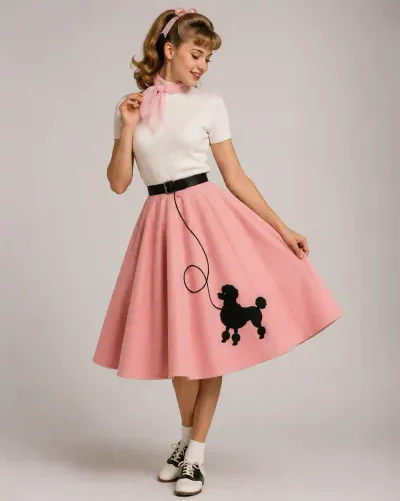
A felt circle skirt appliquéd with a poodle motif - pure teenage novelty wear, and probably the single most recognizable garment of the decade, even though it actually originated in the late 1940s.
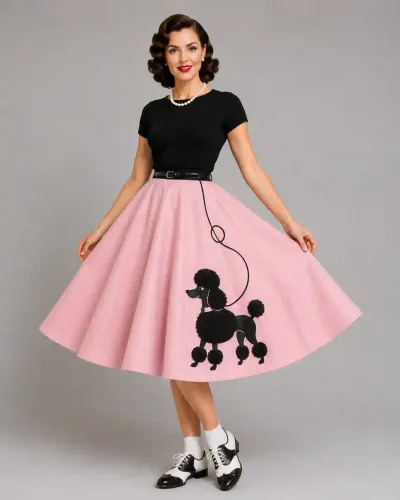
If the circle skirt is the sensible parent, the poodle skirt is its novelty-obsessed teenage kid - same basic construction, but built entirely to be fun and a little silly. It's hard to think of a garment that says "1950s teenager" faster, even though it began in late 1947, when Juli Lynne Charlot made a felt skirt for a Christmas party in Los Angeles. That origin story, and why felt suited it so well, is in the felt entry. This one is about the garment itself: how it was put together, how it spread, and the difference between a skirt from a store and one from a kitchen table.
Structurally it's about as simple as a skirt can be. Cornell's costume collection has a felt circle skirt from 1951-53 that is, in its curators' words, literally a circle with an opening for the waist and no seams to sew. What finishes it is a waistband and a placket, and the FIT museum's example closes with a zipper at the left side. Length is where the fabric goes: LACMA's 1952 poodle skirt measures 32 inches at centre back, and every extra inch of length adds to the diameter of the whole circle. The fullness it gives is the New Look silhouette brought down to a teenager's budget, and FIT's curators make exactly that comparison. Over a stiffened net petticoat it stands out and swings, and without one it hangs in soft, heavy folds.
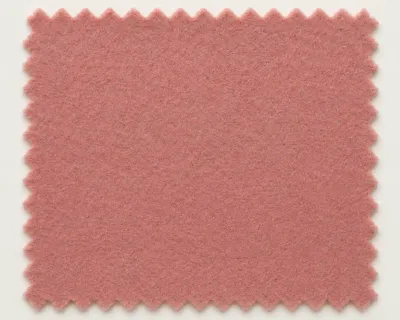
The appliqué is the part people get wrong. Charlot didn't glue anything on. She sewed, she said, "just well enough by hand" to appliqué green felt Christmas trees onto her first skirt, and she decorated them with trinkets from her mother's cigar box. Felt makes that easy, because a cut edge doesn't need turning under: you can stitch a motif down through its raw edge with small, even stitches and it stays crisp. Store skirts piled more on top. LACMA's black wool felt skirt, sold by I. Magnin in San Francisco in 1952, has two appliquéd poodles worked with plastic sequins and glass beads, pink ribbon trim and a pale blue band at the scalloped hem. The Met has a 1952 skirt by another maker, Florence Schulman, catalogued with a dog motif in wool, nylon and glass. That kind of surface work is what turns a flat felt cut-out into a little scene.
Charlot's skirts spread through stores first. A Beverly Hills boutique sold out of her Christmas skirts and asked for something that wasn't seasonal; dachshunds sold, and poodles sold better. Soon she was running a factory with about fifty workers, and her mother once pawned a diamond ring to meet the payroll. The motifs went well beyond dogs - frogs on lily pads, Parisian street scenes, racehorses, Champagne glasses, pink elephants - and she added matching blouses, hats and handbags. Imitators copied the idea so widely that any appliquéd circle skirt came to be called a poodle skirt, whatever was on it.
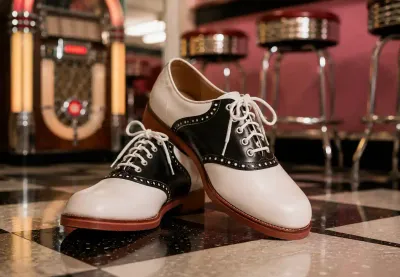
Those store skirts sold for around $35 in the early 1950s, which is why the home-made version mattered so much. FIT has a denim circle skirt from about 1952, scattered with printed and stuffed vegetable appliqués instead of a poodle, and its catalogue notes that these skirts could be made at home from inexpensive materials. That's the real split in the garment's history. A store skirt with beads and a label was a fairly expensive novelty. A home-made one cost a few yards of fabric and some evenings of hand stitching, with whatever motif the maker liked, and it went out with saddle shoes and a sweater set just the same. Both belong to the rise of teen fashion, but only one of them was within reach of most of the girls who wore it.
Sources
- "Juli Lynne Charlot, creator of the poodle skirt, dies at 101" - The Boston Globe (from The New York Times), 5 March 2024
- "Jewish Life Stories: The inventor of the poodle skirt, Time Warner's 'Jewish, frumpy intellectual'" - Jewish Telegraphic Agency, 20 March 2024
- Woman's Skirt (Poodle Skirt), I. Magnin & Co., 1952 - LACMA Collections
- Skirt, Florence Schulman, 1952 (1978.341.1) - The Metropolitan Museum of Art
- Skirt, USA, c. 1952 (90.26.1) - The Museum at FIT
- Embroidered Felt Circle Skirt and Nylon Blouse, 1951-53 - Cornell Costume and Textile Collection, Clothing in 3D