The 1960s late 1960s
Jean Muir
A British designer known for a quiet mastery of jersey and suede that stood apart from the decade's louder geometric and psychedelic instincts almost entirely on purpose.
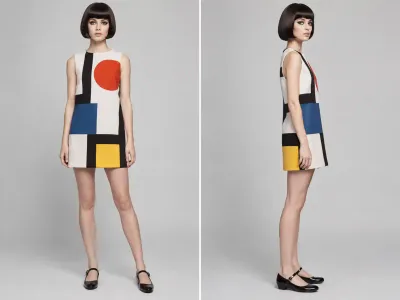
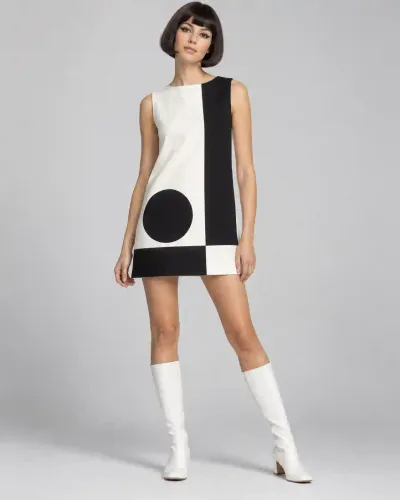
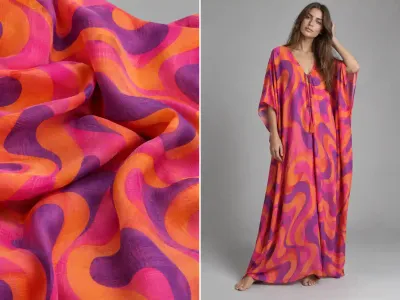
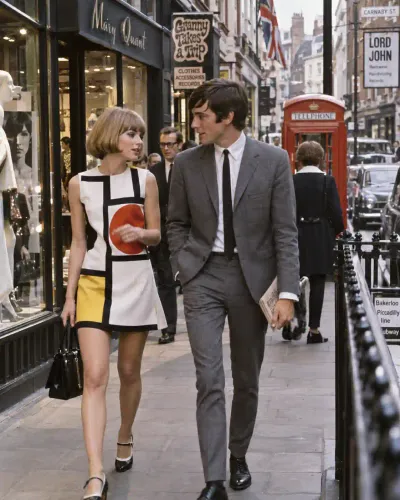
Jean Muir's reputation rests on a kind of restraint that stands out precisely because so much of this decade was moving in the opposite direction. Where the mod silhouette leaned on bold geometry and the late decade's psychedelic prints on maximal colour and pattern, Muir made what the V&A calls "instant classics; distinctive and strong yet very subtle" - clothes that were cut with real precision and deliberately unshowy about it.
Unlike most of the young London names, she learned her trade inside the industry rather than at art school. Born in London in 1928, she started at Liberty in 1950, on the shop floor in the lingerie and made-to-measure departments and as a sketcher for ready-to-wear, then moved to Jacqmar and, as a designer, to Jaeger from 1956. Next came her own company, Jane & Jane, backed by the manufacturer David Barnes. A Jane & Jane dress was the Fashion Museum Bath's Dress of the Year for 1964, chosen by the Fashion Writers' Association - only the second ever, after Mary Quant's in 1963. The V&A has a Jane & Jane dress from about 1965 that shows her early hand: a sleeveless, boat-necked shift of bright pink silk dupion, cut straight to just below the knee and shaped only with bust darts, fastening at the left shoulder with a hook and eye hidden under a rouleau bow, with a zip in the left side seam. It was bought from the 21 Shop at Woollands in Knightsbridge, an in-house boutique modelled on Quant's Bazaar. Home sewers could get her too: Butterick issued a Jean Muir dress as pattern 4129 in its "Young Designer" series, and the London Museum has a copy.
She launched the Jean Muir label in 1966, and the V&A's purple suede dress from that year shows how much work she was willing to hide. It belonged to the fashion journalist Ernestine Carter. The long shirt sleeves are pin-tucked at the top, the front is pin-tucked to just above the waist, a high stand collar closes with one button, and the dress opens down the front on a long zip, with a kick pleat at the centre back. The hem is an extra band of suede, topstitched in place and stiffened on the inside, so the skirt hangs cleanly - suede doesn't take a turned-up hem gracefully the way cloth does. A yellow linen day dress from spring 1967 is just as considered: a princess line with three flared front panels and four at the back and no waist seam, a row of six linen-covered buttons on loops, and three-quarter dolman sleeves with diamond-shaped gussets let in at the underarm so the wearer can lift her arms without dragging the whole bodice.
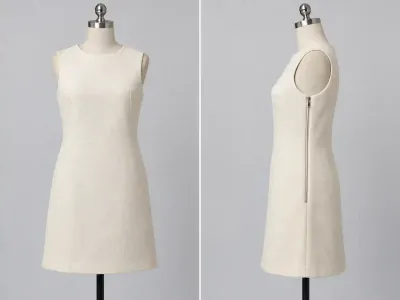
Muir won Dress of the Year again in 1968. A year later she made the wedding dress for Pamela Talmey, a former Vogue editor, who married Lord Harlech on 11 December 1969: cream worsted wool twill with a high standing band collar, puffed sleeves and an empire waist, its only trimming an applied Celtic design in couched braid on the bodice. It looked bridal, and could be worn again afterwards as an evening dress.
Her later fame rests on jersey, angora, wool crêpe, suede and soft leather, used season after season regardless of trends. She fitted every toile on her own body, which she believed gave her an advantage over male designers: "When I try on a dress, I can feel if something is wrong; I can tell if it's not sitting properly on the shoulders or the bust or the hip." She also insisted fashion was an industry rather than an art. Her work is a reminder that "the 1960s" covers more sensibilities than its loudest, most photographed examples suggest - and that a quiet, disciplined designer could build a real career running alongside all that noise.
Sources
- Dress of suede, Jean Muir, 1966 - V&A Collections
- Dress of pink slubbed silk, Jean Muir for Jane & Jane, about 1965 - V&A Collections
- Linen day dress, Jean Muir, spring 1967 - V&A Collections
- Wedding dress, cream worsted wool twill, Jean Muir, 1969 - V&A Collections
- Butterick 'Young Designer' pattern 4129, designed by Jean Muir, 1962-1966 - London Museum
- Kevin Almond, "Muir, Jean", Contemporary Fashion - Encyclopedia.com
- Dress of the Year - Fashion Museum Bath