The 1990s throughout the 1990s
Tie-Dye and the Hippie Revival
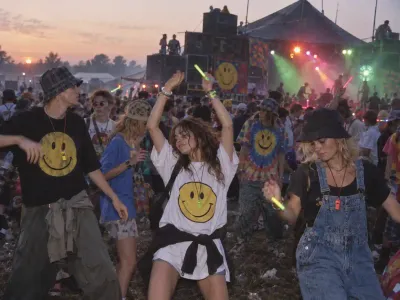
The 1960s resist-dyed T-shirt came back in the 1990s through Grateful Dead tours, British raves and travellers' camps, and the 'hippie' catwalks of spring 1993, before the high street sold it by the rack.
Tie-dye never quite went away. Through the 1980s the Deadheads, who followed the Grateful Dead from show to show, kept wearing it. The reference book Fashion, Costume, and Culture says the band's concerts "became festivals of tie-dye," and that the people who sold shirts in the parking lots were known as "dyes." The V&A has a 1991 example by Liquid Blue of Massachusetts. Its founder, Paul Roidoulis, was a Deadhead who sold tie-dyed shirts out of his car before launching the company in 1987, with Anna Lisa Sorensen designing almost all of its dye patterns. This one was made for the band's shows at Madison Square Garden, with David Opie's drawing of skeletons riding the New York subway printed over a swirl of colour. It belonged to a young Londoner, Richard Velleman, who collected and wore T-shirts; after his death in 1995 his collection was given to the museum in his memory.
The catwalk came back to it in spring 1993, the same season as grunge. Anna Sui called her New York collection her "antique clothing" hippie show, and Naomi Campbell opened it in rainbow knit bell-bottoms, a cropped suede vest, love beads and a crocheted cap. "I keep saying '70s," Sui had told the Chicago Tribune in 1992, "because, to me, that was the last time people - women - dressed to express themselves." The Museum at FIT's look from that collection, described in the choker entry, is in rainbow-striped rib knit too. Dolce & Gabbana's spring/summer 1993 collection, which the V&A displayed as "Fashion Hippy," included a three-piece trouser suit patched together from clashing silks, brocade, Lurex and velvet, worn with a flowered silk blouse with jewelled buttons. These were rich, worked versions of the hippie silhouette and its psychedelic prints, and the mood returned at the end of the decade with Tom Ford's "Las Vegas hippie" collection for Gucci, part of the Y2K look.
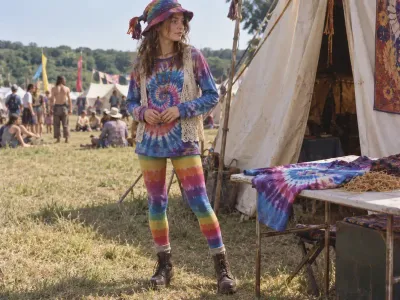
In Britain the route ran through dance music and the countryside. The rave scene had its own tie-dye: the V&A's 1994 Streetstyle exhibition showed a long-sleeved T-shirt dyed in blues and purples and printed with Ant Cooper's "Vortex" design for his London label Have A Nice Day, in an outfit recreating the Madchester and rave look of 1987-88. It also showed a tie-dyed cotton hat with a tassel from the outfit of Fraggle, a member of the Dongas, an environmental protest group who travelled from campaign to campaign. Her first festival had been the Stonehenge solstice in 1989, and she was campaigning against the Criminal Justice Bill. "We dress brightly because we're positive," she told the museum. By then, Fashion, Costume, and Culture notes, tie-dye had become mainstream, often mass-produced and sold in shopping malls.
The technique is simple. The Encyclopedia of Clothing and Fashion describes tie-dye as a resist method: you bind or compress parts of the cloth with thread, string or rubber bands so the dye can't reach them and untie it to find the pattern. Knotting gives bold, turbulent marks, pleating gives stripes, and pinching the centre and twisting the whole shirt into a flat coil, then banding it like a pie, gives the classic spiral. The brightest results come from fibre-reactive dye. In 1956 ICI launched Procion MX, the first fully water-soluble reactive dyes for cotton, which bond chemically with the fibre in mild alkali. That's why home dyers soak cotton in a soda ash solution, squirt on the colours, and leave the bundle in a bag for a day before rinsing. Wash out any finish first, and remember that polyester sewing thread won't take the dye, so a T-shirt's seams come out white.
The colours were new, but the reasons for wearing it were old. The Dongas' homemade clothes were close kin to the back-to-nature wardrobe of twenty years before: a way of saying you stood outside the system, in cloth that never comes out the same twice.
Sources
- T-shirt, tie-dyed and printed cotton, Liquid Blue for the Grateful Dead, tie-dye by Anna Lisa Sorensen, artwork by David Opie, 1991 (T.609-1997) - V&A Collections
- "Tie-Dye" (Fashion, Costume, and Culture) and "Tie-Dyeing" (Encyclopedia of Clothing and Fashion) - via Encyclopedia.com
- "#TBT: Anna Sui's Glorious Mash-Up of Hippie and Grunge" - Yahoo Style, 10 September 2015
- "Rainbow Grunge" ensemble, Anna Sui, spring 1993 (93.70.1) - The Museum at FIT
- Trouser suit, patchwork silk, brocade, Lurex and velvet, Dolce & Gabbana, spring/summer 1993 (T.616 to 618-1993) - V&A Collections
- T-shirt, tie-dyed and printed cotton, Ant Cooper's 'Vortex' print for Have A Nice Day, 1991-1994 (T.718-1994) - V&A Collections
- Hat, tie-dyed cotton, part of a New Age Traveller costume worn by Fraggle, 1989-1993 (T.494-1994) - V&A Collections
- David M. Lewis, "Colour and Textile Chemistry - A Lucky Career Choice" (Olney Award lecture, University of Leeds) - AATCC, 2008