The 1980s early 1980s
The Preppy Handbook and Preppy Culture
A 1980 satirical guide to old-money dressing that readers took as genuine instruction rather than a joke, turning a narrow, class-specific style into a nationwide youth fashion movement almost overnight.

The Official Preppy Handbook came out from Workman Publishing in New York in 1980: 224 pages, edited by Lisa Birnbach from a concept by Jonathan Roberts, with photographs by Robin Holland and drawings by Oliver Williams. The Library of Congress filed it, quite correctly, under "Preparatory schools - United States - Anecdotes, facetiae, satire". Readers filed it under "how to". It spent 38 weeks on the New York Times best-seller list and, by GBH's count, sold 1.3 million copies - a remarkable number for a joke about a social class that was, by definition, small.
The trouble with the joke, as Amanda McCorquodale put it in the Miami New Times thirty years later, was that a book-long dig at a WASP subculture was also "a handy field guide" for anyone hoping to join it. The satire works by being exact - the right shoe, the right sweater, the right way to wear it - and exactness is what an aspiring reader wants from a manual. You can't really parody a dress code by describing it accurately; you just publish it.
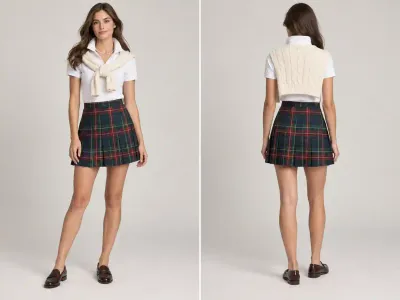
It's worth being clear that the handbook named a boom rather than starting one. In February 1980 Phyllis Feldkamp, writing for The Christian Science Monitor, was already reporting prep as a spring trend, and her piece reads like a merchandising memo. Ralph Lauren had his costly "Brooksy Ivy"; new companies like J. G. Hook were making middle-priced updates of "Seven Sisters" styles; and a number of Seventh Avenue's junior mass-market manufacturers had come up, as she drily put it, with "what a large group of Americans have never stopped wearing." The bedrock customer, who swore by Talbots and the other catalogues, "likes what she likes, and she doesn't pay much attention to fashion with a capital F" - so the merchandising of new preppy, Feldkamp concluded, was "really the old story: If you can't lick 'em, join 'em." The clothes themselves are in the preppy silhouette entry; the commercial engine behind them is Ralph Lauren's.
Britain had its own version, and the parallel is close. The term "Sloane Ranger" had been coined at Harpers & Queen in 1975 - a sub-editor, Tina Margetts, came up with it, after the working title "The Knightsbridge Knotted", from the way these women tied their headscarves - but it took off in 1982, when Ann Barr and Peter York turned it into The Official Sloane Ranger Handbook. According to Graham Stewart in The Critic, it sold more than a million copies, became the best-selling trade book of its decade, and had Lady Diana Spencer, a year into her marriage, on its cover. York took the sales, many times the number of genuine Sloanes, as proof that the lifestyle could be adopted as well as inherited. The V&A, cataloguing a pair of green Hunter wellingtons from 1989, quotes the book on early-1980s west London: Sloanes "sprout green wellies in wet weather like a plague of frogs."
Both books were written with a raised eyebrow, and both were bought in huge numbers by readers who took the eyebrow off. That's the uncomfortable thing at the centre of preppy culture - a style whose whole point was that you couldn't buy it, sold in vast quantities to people who bought it - and it's the same move power dressing was making in the office at the same time: learn the code of the people already in charge, and wear it.
Sources
- Lisa Birnbach (ed.), The Official Preppy Handbook (Workman, 1980) - Open Library record
- Lisa Birnbach - GBH
- Amanda McCorquodale, "Class Warfare" - Miami New Times, 18 November 2010
- Phyllis Feldkamp, "Preppy is trendy" - The Christian Science Monitor, 27 February 1980
- Graham Stewart, "So long, Sloanes" - The Critic, July/August 2020
- Ann Barr and Peter York, The Official Sloane Ranger Handbook (Harpers & Queen, 1982)
- Pair of Wellington boots, 'Hunter Green', Gates Rubber Company, 1989 - V&A Collections