The 1990s early 1990s
Mom Jeans
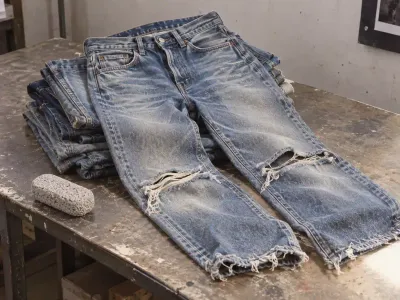
High-waisted, roomy-hipped jeans in rigid denim with a tapered, often cropped leg - the everyday denim of the late 1980s and early 1990s, only nicknamed 'mom jeans' after a Saturday Night Live sketch in 2003.

Nobody in 1991 said "mom jeans". They said jeans. The name arrived more than a decade later, on 10 May 2003, when Saturday Night Live ran a fake advertisement written by Tina Fey, with Fey, Amy Poehler, Maya Rudolph and Rachel Dratch as suburban mothers in enormous high-waisted denim. "So this Mother's Day," the voiceover said, "give her something that says, 'I'm not a woman anymore. I'm a mom!'" Fey later explained that she'd written it the week she bought "a really unfortunate pair of jeans." The Irish Times thinks it unlikely she coined the phrase, but the sketch is what fixed it. So the name is a joke from 2003 about jeans from the decade before, and I use it here only because everyone now does.
What the joke described was simple. Levi Strauss & Co.'s own account calls the style "high-waisted with a cropped, slightly tapered leg", and a staple of the 1980s and 1990s; it points to Susan Sarandon and Geena Davis in Thelma & Louise (1991) and the women of Beverly Hills, 90210. The shape had been building for years. On this site you can watch the flare drain out of the leg in late-1970s denim, where Calvin Klein's 1979 jeans are high-waisted and tight, and then see the taper arrive in the 1980s, as in the V&A's stone-washed Jean Machine pair in the acid-wash entry. The early 1990s kept the waist and the taper and dropped the drama. The Encyclopedia of Clothing and Fashion describes a return to "classic styles" and stiff dark denim, often worn with cuffed hems like a bobby-soxer's.
The best-known pair was the Levi's 501. The company's historian, Tracey Panek, writes that the women's 501 launched in 1981 in "rigid unwashed denim" and was sold to shrink: women bought a size or more too big and washed them down to fit. By the end of the 1980s it had "hit peak fame", and in January 1990 Peter Lindbergh's British Vogue cover of five supermodels put them in the jeans - "a look that would epitomize the era," she says.
Cutting them taught me how much a high waist simplifies a pair of jeans. The waist is the narrowest point of the body, so a straight waistband sits flat there; the low-rise waistband later in the decade needed a curved band because it sat where the body was still widening. The hard part is the drop from waist to hip, which jeans take out at the back yoke and in the shaping of the centre-back seam. Below that comes room through the seat and thigh, then a steady taper to a narrow hem at or just above the ankle bone. In rigid cotton with no stretch, every bit of fit has to come from the pattern, which is why these jeans looked roomy over the hips and pinched at the ankle - the outline the sketch made fun of. The long rise has one practical advantage that anyone who wore the later hipsters will appreciate: you can sit down without the back gaping.
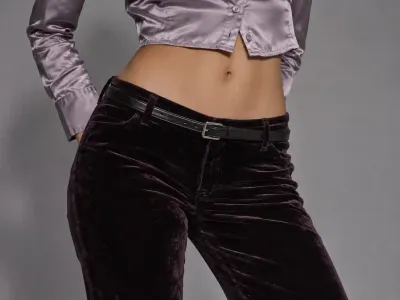
They went with T-shirts and bodysuits tucked in and belted, and with the shrunken baby tee, whose hem just met the waistband. Then the decade pulled the rise apart from both ends. Grunge wore jeans baggier and ripped at the knee, hip-hop wore them huge and low, and by the end of the decade the low rise had won. Levi's says the high-waisted style faded in the early 2000s, which is exactly when SNL could make it a punchline - and it was back in Levi's own range by 2016.
Sources
- "SNL's 'Mom Jeans' Was Inspired by Tina Fey's Experience at a Store" - NBC Insider, 20 January 2025
- Sarah Waldron, "How mom jeans became sexy" - The Irish Times, 7 July 2015
- "From Mom Jean to Wedgie Fit: The Evolution of an Iconic Trend" - Unzipped, Levi Strauss & Co., 6 May 2016
- Tracey Panek, "Celebrating 40 Years of the Women's 501 Jean" - Unzipped, Levi Strauss & Co., 13 May 2021
- "Jeans" - Encyclopedia of Clothing and Fashion, via Encyclopedia.com