The 1990s mid-to-late 1990s
Friends, Clueless and TV Style
'The Rachel' haircut, slip dresses over T-shirts, plaid skirt suits and knee socks - how a sitcom and a teen film became the decade's most influential style guides, taking designer and street trends straight to the high street.
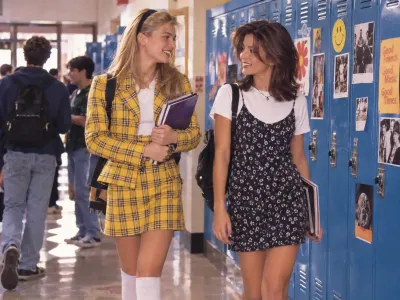
Film and television have shaped fashion throughout this site, from 1930s Hollywood to 1980s prime-time soaps. In the 1990s, a sitcom and a teen film became two of the most copied style sources of the decade, and they did it by showing ordinary-ish young women in clothes people could actually buy.
The sitcom was Friends, which began in 1994 and was hugely popular around the world. Its most influential style moment was a haircut: the layered, bouncy shoulder-length cut worn by Jennifer Aniston's character, Rachel Green, created by the hairdresser Chris McMillan. "The Rachel" became one of the most requested haircuts of the decade. Rachel's clothes were just as widely copied: slip dresses, short skirts with knee-high socks or boots, fitted cardigans and vests, and simple, casual minimalist-leaning outfits. Because the characters were young adults in ordinary jobs, their clothes felt achievable, and high-street shops sold versions of them.
The film was Clueless (1995), a comedy set in a Beverly Hills high school and loosely based on Jane Austen's Emma. Its costume designer, Mona May, dressed Alicia Silverstone's character, Cher Horowitz, in a playful mix of designer fashion and schoolgirl styling: matching plaid skirt suits (the yellow tartan outfit became iconic), knee socks, mini skirts, cardigans, slip dresses, and fluffy accessories. The film's colourful, preppy, fun look was a deliberate contrast to grunge, and it had a big influence on teen fashion.
Other shows added to the mix. My So-Called Life (1994) put grunge-influenced flannel and layers on a teenage heroine, and at the end of the decade Sex and the City (1998), with its costume designer Patricia Field, began its long influence on how women dressed and thought about designer fashion.
I think these shows matter because they worked as a bridge. Designer ideas and street trends reached millions of people through characters they felt they knew, and the high street translated those looks quickly and cheaply. That made TV and film one of the most powerful forces in 1990s fashion - and it laid the groundwork for the celebrity- and screen-driven style culture of the following decades.