The 1970s 1970s
The Jumpsuit
Trousers and a top built as one continuous garment, with no break between top and bottom to interrupt the silhouette - a single piece that could carry a woman from a disco floor to a dinner reservation without a second thought.
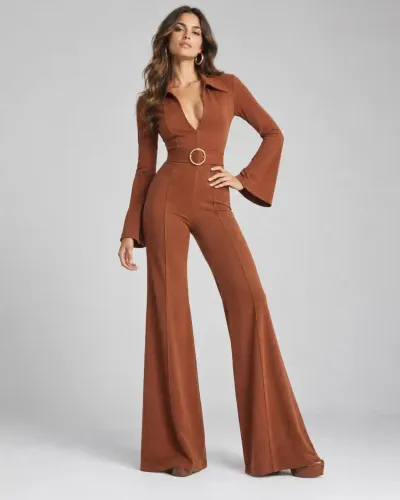
The jumpsuit joins a trouser to a bodice in a single continuous garment, so there's no point where a top meets a bottom. That does real practical and visual work at once: no waistband to gap or ride up, no tucking in, and a vertical line from shoulder to ankle that separates can't quite match. It doesn't always mean there's no seam at the waist - many are cut in two parts and joined there, and some have a belt or waistband sewn on - but the eye reads one piece.
The 1970s jumpsuit grew out of two very different ancestors. One was the workman's boiler suit. The V&A has one from the London boutique Mr Freedom, designed by Jim O'Connor in 1970, in cotton blocked in green, blue, black and red, with patch pockets, red topstitching and five big red buttons down the front, fastening the way a man's garment does. It probably belonged to Talitha Getty, and the museum thinks it was meant to be unisex. The other ancestor was the stretch catsuit of the Space Age. The V&A's label for a 1971 knitted jumpsuit by the London label Ritva puts the two together: the jumpsuit was "a fashionable variation of the boiler suit" that caught on in the late 1960s, and Ritva was among the first to knit one. It's full length, long sleeved and zipped up the front, black stocking stitch with the bodice striped from red to beige, and the cuffs and hems rolled back to show the purl side. Outworkers made Ritva's pieces on domestic knitting machines, and each was finished by hand in the workroom.
From a dressmaker's point of view, the hard part of a jumpsuit is length, not width. A woven one has to fit from shoulder to crotch as well as round the body, and if that measurement is short you can't sit down or raise your arms. Knit forgives a lot of that, which is one reason jersey suited it so well. A woven one needs a long opening and careful cutting. The V&A's canary yellow crêpe jumpsuit, made for Ella Fitzgerald by Don Loper of Beverly Hills in the late 1960s or early 1970s, shows how a couture-trained maker handled it: a concealed zip about 62 centimetres long down the centre back, a pleated waistband with a bow to define the waist, flares more than a metre wide at their fullest, and a separate pair of inner trousers, shaped to follow the outer ones with slightly narrower flares, so the crêpe hangs cleanly.
Halston made the evening jumpsuit his own across the whole decade, not just its second half. The Met holds more than half a dozen of his jumpsuits, dated from the early 1970s to the middle of the decade, among them a rayon evening jumpsuit of 1970-73 given by Lauren Bacall, and Indianapolis has his 1971 "hot pants jumpsuit," cut to the micro length. Giorgio di Sant'Angelo went further towards the body: his 1975 ensemble in the V&A is a pink spandex jersey jumpsuit, halter-necked and backless, under three layers of printed chiffon coats.
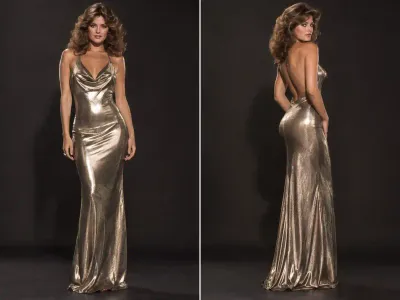
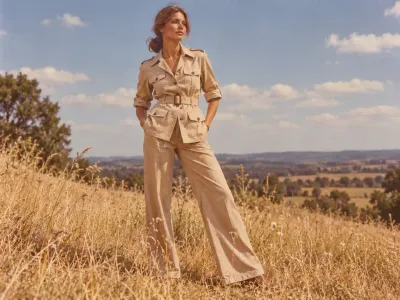
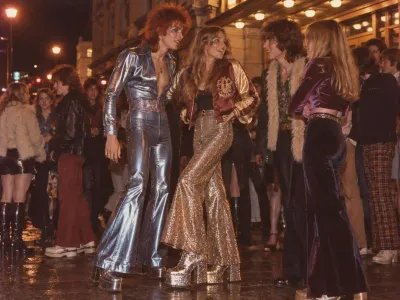
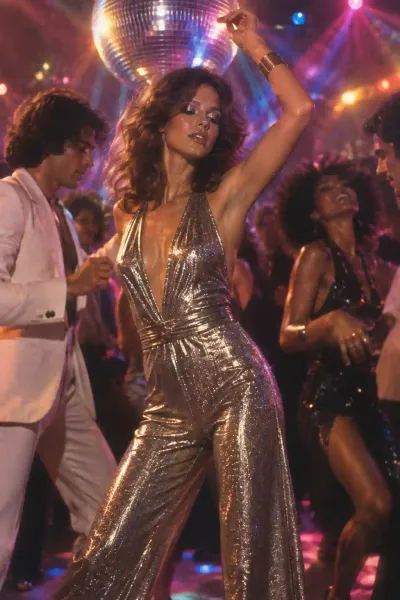
By the time Studio 54 opened in 1977, then, the evening jumpsuit was well established, and its slinky, bare-backed form belongs with the halter top in the disco silhouette. There were daytime versions too, in cotton and in the safari style, and on stage glam rock pushed the shape to its most theatrical. In the late 1970s, as FIT's decade overview notes, Norma Kamali was bringing jumpsuits into her sportswear, and her parachute-cloth versions took the shape back towards utility and on into the 1980s.
Sources
- Jumpsuit, Ritva Ross for Ritva, frame-knitted acrylic and rayon, London, 1971 (T.56-2000) - V&A Collections
- Boiler suit, Jim O'Connor for Mr Freedom, cotton, London, 1970 (T.217-1974) - V&A Collections
- Jumpsuit worn by Ella Fitzgerald, Don Loper, Beverly Hills, late 1960s or early 1970s (S.38-2018) - V&A Collections
- Evening jumpsuit, Halston, 1970-73, rayon, gift of Lauren Bacall (1979.324.5) - The Metropolitan Museum of Art
- Ensemble, three printed chiffon coats over a spandex jersey jumpsuit, Giorgio di Sant'Angelo, 1975 (T.15:1 to 4-2010) - V&A Collections
- Hot pants jumpsuit, Halston, 1971 (81.259) - Indianapolis Museum of Art at Newfields
- 1970-1979 (decade overview) - Fashion History Timeline, Fashion Institute of Technology