The 1940s postwar (1945-1946)
The Théâtre de la Mode
In 1945, with fabric still scarce, the Paris couture houses dressed more than two hundred wire dolls in miniature couture and sent them touring - a fundraiser that doubled as Paris announcing it was back.
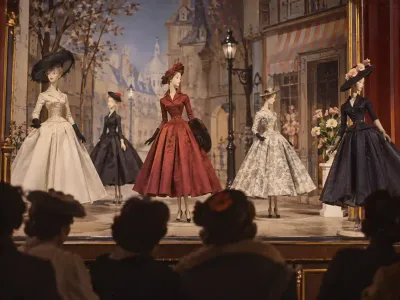
This is one of my favourite stories in all of fashion history. In 1945, Paris had been liberated, but there was almost no fabric, very little money, and a real fear that the rest of the world - especially America - had learned to do without French fashion. The couture houses' answer was to make their clothes tiny.
The Théâtre de la Mode was organised by the Paris couture trade body, then led by Lucien Lelong, to raise money for the war-relief charity Entraide Française. The driving force behind it was Robert Ricci, son of the designer Nina Ricci. The idea was simple and clever: instead of full-size garments, which would need far more cloth than anyone could spare, each participating house dressed dolls about 70 centimetres tall, made on delicate wire frames with sculpted plaster heads. Dozens of couture houses took part, from Balenciaga and Madame Grès to Balmain, and milliners, shoemakers, hairdressers, and jewellers made miniature hats, shoes, wigs, and accessories to scale. The dolls were set in little theatrical scenes designed by artists including Christian Bérard and Jean Cocteau.
The detail is extraordinary. These aren't doll clothes in the toy sense - they're real couture in miniature, with proper linings, working buttons, and hand-finishing, cut by the same workrooms that made clothes for full-sized clients. Some of the outfits, especially in the refreshed 1946 versions, already hint at the longer skirts and softer shoulders of the postwar softening, so the dolls are also a snapshot of the silhouette starting to shift.
It opened in Paris in March 1945 and drew huge crowds, then toured Europe before travelling to the United States in 1946, to New York and San Francisco, with refreshed fashions. That American leg was the real point: after years in which American designers had stepped into the gap left by the occupation, Paris was reminding its most important market of what it could do. A year later, Dior's New Look finished the argument.
The dolls themselves nearly vanished. After the tour, they ended up at the Maryhill Museum of Art in Washington State, where they stayed largely forgotten for decades, until they were restored and shown again, including in Paris and New York around 1990. Their original sets had been lost, and new ones were made. I find the whole thing oddly moving - a whole industry, starved of materials, proving it still had the skill by working at a third of life size.